
No products in the cart.
Automatic Watch Winding Guide & TPD Database
At Aurawinder, we understand that a luxury automatic watch is more than just a tool for telling time—it is a masterpiece of micro-engineering. To maintain the precision and longevity of your timepiece, keeping it wound correctly is essential. Each caliber has its own unique “heartbeat,” requiring specific Turns Per Day (TPD) and rotation directions to stay in peak condition.
Why Precision Winding Matters? Setting your watch winder incorrectly isn’t just a matter of convenience; it’s about protection. An inadequate TPD setting may leave your watch stopped when you need it most, while excessive winding in a low-quality device can cause unnecessary tension on the mainspring’s slip-clutch. Our comprehensive database provides factory-recommended settings for world-class brands like Rolex, Patek Philippe, and Omega, ensuring your watch receives the exact amount of kinetic energy it was designed for.
Our Commitment to Quiet Excellence Whether your movement requires a clockwise, anti-clockwise, or bidirectional rotation, Aurawinder’s advanced Mabuchi motors and programmable settings offer a silent, bespoke environment for your collection. Simply find your model in our database below, adjust your Aurawinder settings, and rest easy knowing your legacy is in safe hands.
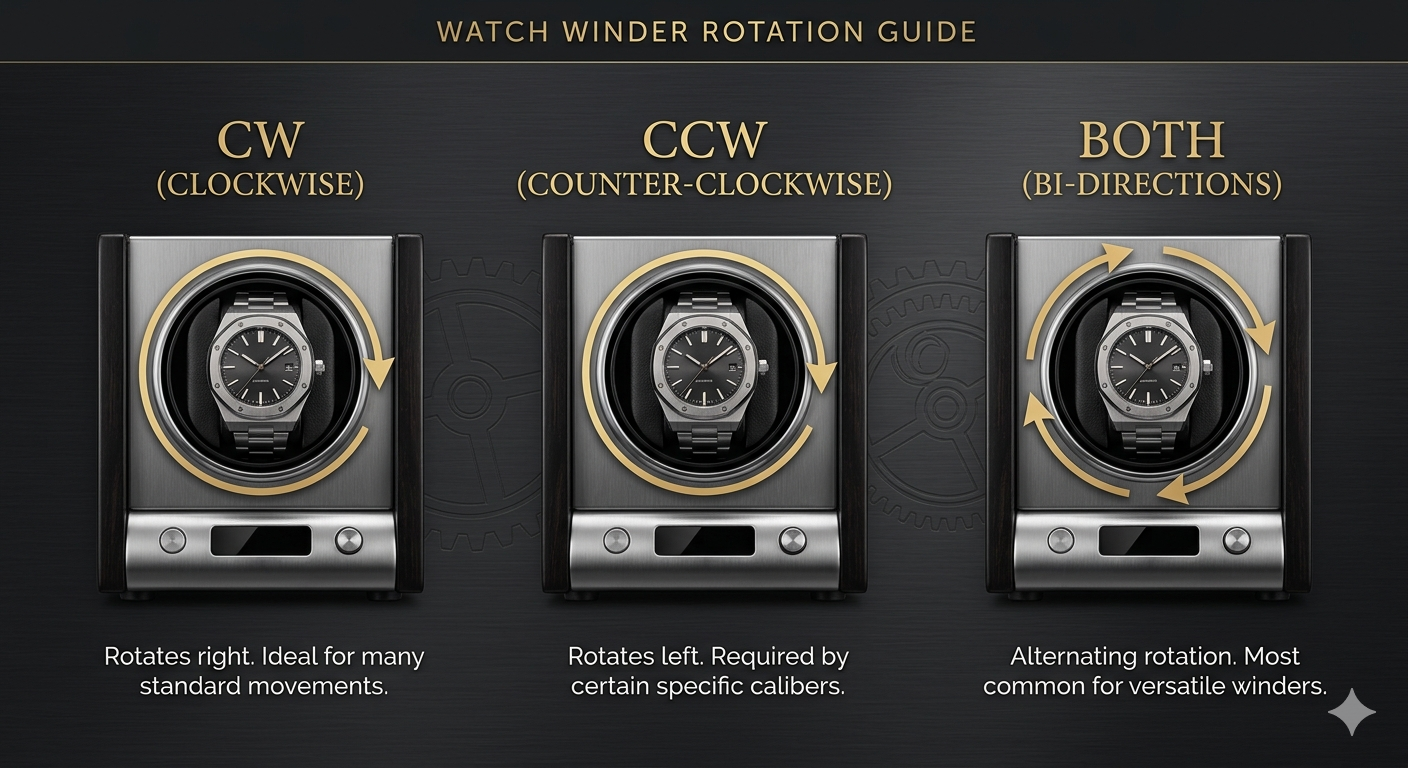 Find the perfect Turns Per Day (TPD) and direction settings for your luxury timepiece
| Brand | Movement / Model | Direction | TPD |
|---|---|---|---|
| Rolex | Submariner, GMT, Daytona (All Modern Calibers) | Both | 650 |
| Omega | Seamaster, Speedmaster, Constellation (Co-Axial) | Both | 720-800 |
| Patek Philippe | Nautilus, Aquanaut, Calatrava (Cal. 324 S C) | CCW | 650-800 |
| Audemars Piguet | Royal Oak, Offshore (Cal. 3120, 4302) | Both | 650 |
| IWC | Portugieser, Pilot (In-house 7-Day / 52000 Cal.) | Both | 800 |
| Tudor | Black Bay, Pelagos, Royal (In-house Calibers) | Both | 650 |
| Cartier | Santos, Tank, Ballon Bleu, Pasha | Both | 650-800 |
| Breitling | Navitimer, Chronomat (B01 Movement) | Both | 650 |
| Tag Heuer | Carrera, Monaco (Calibre 16) | CW | 800 |
| Grand Seiko | Spring Drive (9R), Hi-Beat (9S) | Both | 650-800 |
| Longines | Master Collection, HydroConquest, Spirit | Both | 650-800 |
Expert Tips for Luxury Watch Care
-
Rolex Owners: Most modern Rolex calibers (like the 3235) feature a bi-directional winding rotor. Setting your Aurawinder to “Both” at 650 TPD mimics natural wrist movement perfectly.
-
Patek Philippe & Valjoux 7750: Some movements only wind in one direction (typically Counter-Clockwise). If you set these to “Clockwise,” the rotor will spin freely without tensioning the spring—resulting in a dead watch. Always verify your caliber in our database.
-
The “Jumpstart” Rule: A watch winder is designed to maintain power, not necessarily to wind a completely dead watch from 0 to 100%. If your watch has stopped, we recommend manually winding it 20-30 times before placing it into your Aurawinder.
The Science of Precision Winding: What is TPD?
Turns Per Day (TPD) refers to the number of full rotations the watch winder completes in a 24-hour cycle. It is not a “one size fits all” setting. Every mechanical movement, from a vintage Rolex to a modern Omega Master Chronometer, has a specific kinetic energy requirement.
Using the correct TPD ensures that the mainspring remains sufficiently tensioned to provide a consistent power reserve, maintaining the watch’s accuracy (isochronism) without over-stressing the mechanical components.
Understanding the Power Spectrum
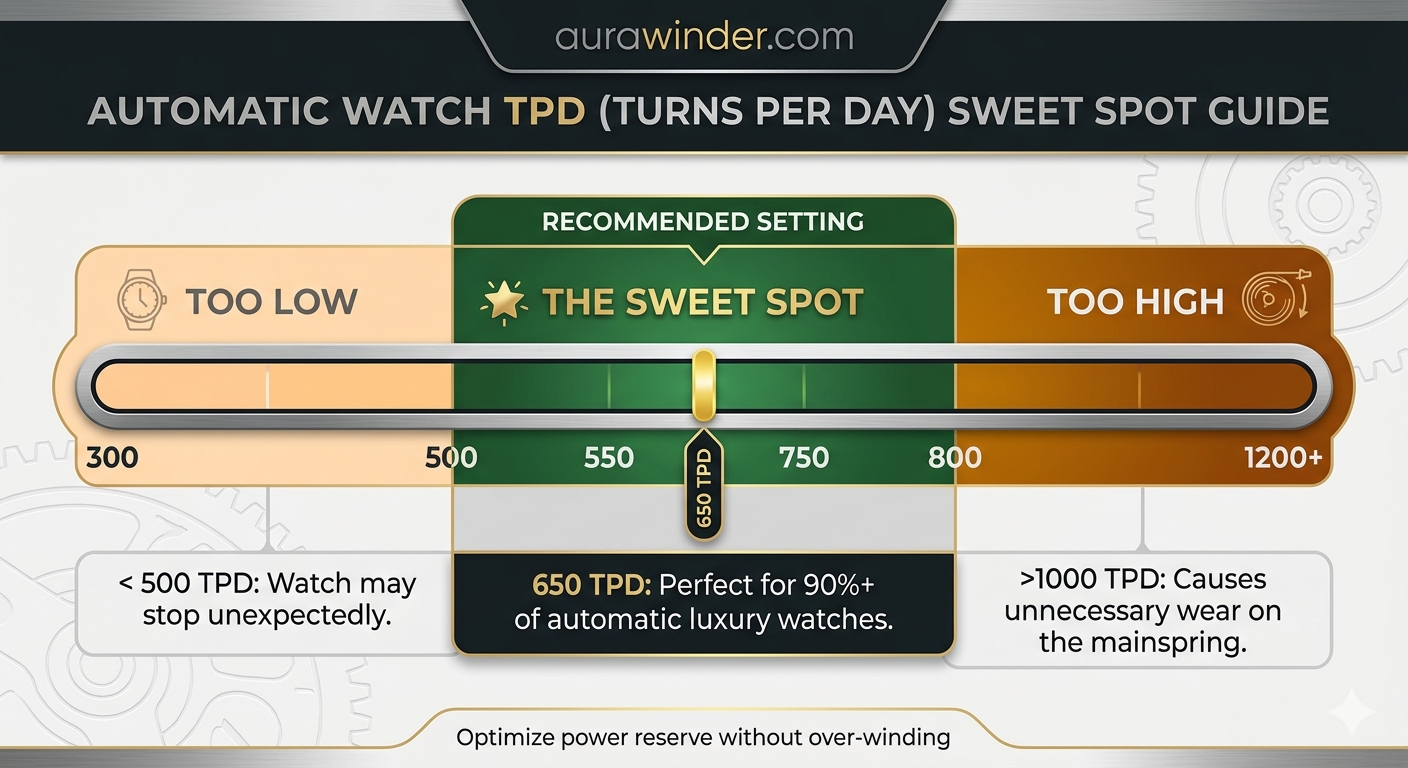
< 500 TPD (Insufficient): Most modern calibers require at least 550 TPD. Setting it too low will lead to the watch losing time or stopping completely within 48 hours, even while in the winder.
650 – 800 TPD (The Sweet Spot): This is the industry standard for 90% of luxury watches, including Rolex, Patek Philippe, and Cartier. It provides enough energy to keep the watch fully wound while allowing the slip-clutch to rest.
> 1000 TPD (High Activity): Usually reserved for complex complications or older, less efficient winding systems. For modern watches, this may cause unnecessary friction on the winding rotor.
Can I overwind my Rolex in a winder?
No, modern Rolex watches have a sliding clutch to protect the mainspring, but it is recommended to use the recommended TPD to reduce mechanical wear.
What happens if I set the wrong direction?
The watch won’t be damaged, but if it’s set in the wrong direction (for example, if a unidirectional winding mechanism is reversed), the watch won’t be able to gain power.
View Best Winders for Rolex
