
No products in the cart.
Best Watch Winder for Rolex Submariner: The Definitive Guide to Anti-Magnetic Engineering & TPD Settings
For many horology enthusiasts, the Rolex Submariner is more than just a dive watch—it is an engineering masterpiece. Driven by modern calibres like the Rolex 3135 (older generations) or the current Calibre 3235, the Submariner relies on a perpetual rotor to stay wound.
However, when it is off your wrist, storing a Submariner in an incorrect environment or a subpar watch winder can lead to long-term issues, ranging from improper lubrication distribution to the silent killer of mechanical accuracy: magnetization.
This technical guide breaks down the exact operational specifications required for the Rolex Submariner and outlines what to look for in a high-caliber watch winder.
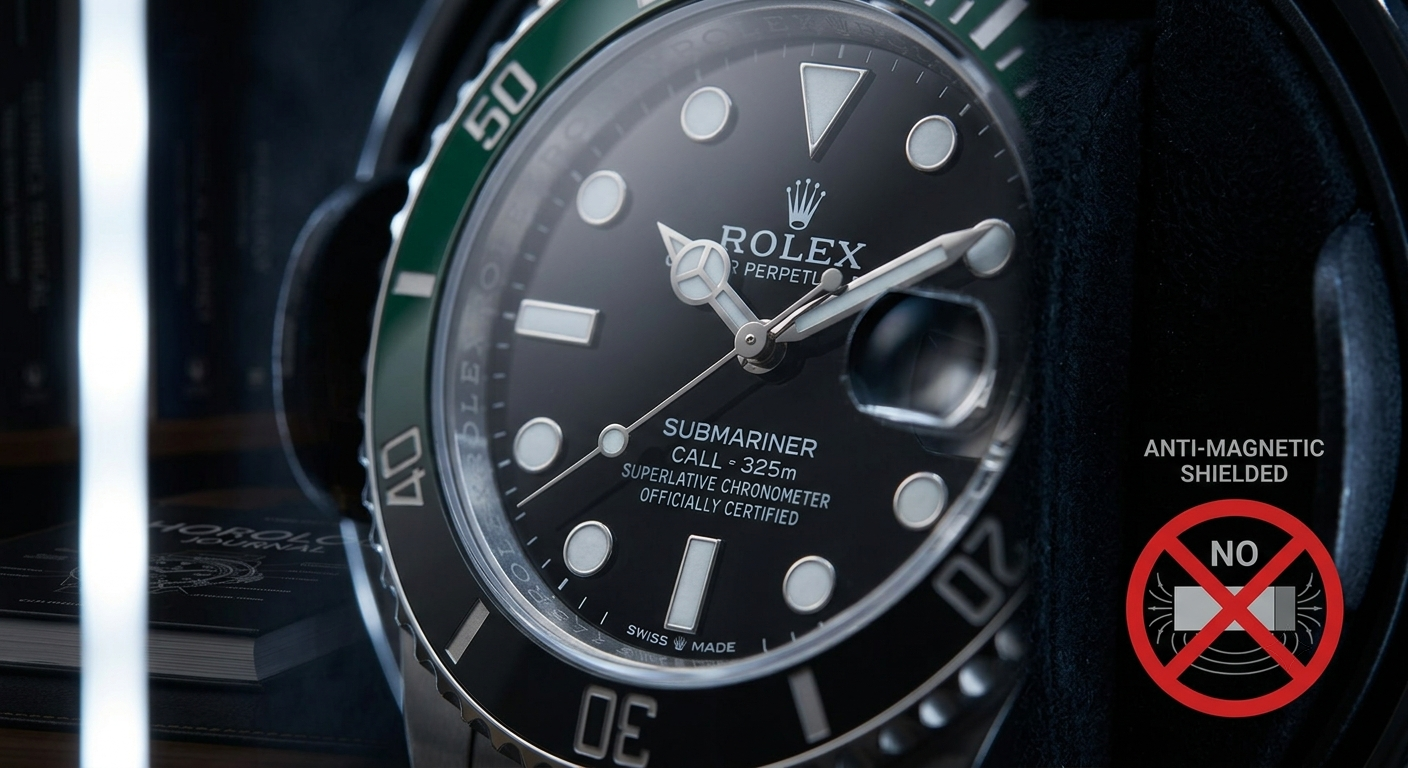
1. Technical Specifications for Rolex Submariner Movements
To keep your Submariner running at its certified Superlative Chronometer accuracy ($+2/-2$ seconds per day), a watch winder must match the precise kinetic requirements of its internal movement.
When choosing a watch winder, it is crucial to consider the Best Watch Winder for Rolex Submariner to ensure optimal performance.
Unlike omnidirectional movements, Rolex calibres utilize a highly efficient bidirectional winding system. Over-winding is prevented by a slip-clutch mechanism on the mainspring, but constantly running a winder at excessive Turns Per Day (TPD) can cause unnecessary wear on this safety clutch.
The Submariner TPD Blueprint
| Watch Model / Reference | Internal Calibre | Required Direction | Optimal TPD Range |
| Submariner Date (Ref. 126610LN) | Calibre 3235 | Bidirectional (Both) | 650 – 800 TPD |
| Submariner No-Date (Ref. 124060) | Calibre 3230 | Bidirectional (Both) | 650 – 800 TPD |
| Submariner Date (Ref. 116610LN) | Calibre 3135 | Bidirectional (Both) | 650 TPD |
Pro Tip: Setting your winder to 650 TPD in a bidirectional mode (meaning alternating clockwise and counterclockwise turns) is the absolute sweet spot for a Rolex Submariner. It provides just enough energy to maintain the power reserve without unnecessarily stressing the mainspring assembly.
2. The Core Engineering Features Your Winder Must Have
A Rolex Submariner is built to withstand extreme maritime pressures, but inside a watch winder, it faces a completely different environment. Here are the non-negotiable technical requirements for an elite winder:
A. Micro-Level Anti-Magnetic Shielding
Every electric motor generates a localized electromagnetic field (EMF). In cheap, unshielded winders, the watch is placed directly on top of this bare motor. Over time, this exposure can magnetize the Submariner’s hairspring.
While modern Rolex calibres feature the Paramagnetic Blue Parachrom hairspring, which offers high resistance to magnetic fields, repetitive, long-term exposure to direct motor EMF can still degrade timekeeping precision.
-
The Solution: Look for winders engineered with high-density magnetic shielding carbon fiber or copper-alloy plates wrapped around the motor to drop the residual magnetic flux to 0 Gauss at the watch holder.
B. Ultra-Quiet, Precision Motors
A luxury watch winder should be felt through the condition of your collection, not heard in your bedroom.
-
The Industry Standard: The gold standard for premium winders is the Japanese Mabuchi motor. These brushless motors utilize high-precision gears that deliver silent operation (frequently below 5 to 10 dB) and a lifespan that matches the longevity of your timepieces.
C. True Intermittent Rotation Logic
A Submariner should not spin non-stop all day. Cheap winders spin continuously for hours, which over-activates the slip-clutch.
-
The Advanced Solution: Intelligent winders employ microprocessor-controlled sleep cycles. For instance, to hit 650 TPD, the winder might rotate for 1 minute, rest for 10 minutes, and then repeat the cycle while automatically alternating directions. This mimics natural wrist movement and allows the movement to discharge power naturally.
3. Top Architectural Styles: Form Meets Horological Function
When choosing the structure of your winder, consider how you intend to display and protect your investment.
The Luxury Showcase (Piano Lacquer or Carbon Fiber)
For displaying a Submariner on a dresser or office desk, multi-layered wood enclosures finished with hand-polished ebony piano lacquer or high-tech carbon fiber provide a stark, elegant contrast to the Submariner’s Oystersteel architecture. Look for units equipped with subtle, non-UV LED ambient lighting to showcase the iconic Cerachrom bezel at night.
The Bio-Metric Security Safe
If you own a highly coveted vintage Submariner (like a “Hulk” 116610LV or a clean 16610), open display might not be wise. High-end Watch Winder Safes combine heavy steel anti-drill construction, fingerprint access, and built-in multiple winder bays. This setup provides dual-layer security: physical protection from theft and mechanical protection from moisture and dust.
Summary Checklist for Rolex Owners
Before purchasing a winder for your Rolex Submariner, ask the manufacturer for verification on these three points:
-
[ ] Does it have independent TPD control? (Can it be set specifically to 650 or 700 TPD?)
-
[ ] Does it support true bidirectional rotation?
-
[ ] Is the motor explicitly shielded against magnetic fields?
Investing in a winder built with these rigorous specifications ensures that whenever you take your Rolex Submariner out of its bay, it is fully wound, perfectly accurate, and ready for your next adventure.

Leave a comment